
From Paper to Structured Data: GenAI Meets OCR
We built a GenAI-powered service that combines OCR with contextual understanding to extract structured data from delivery slips of varying layouts. The system enriches raw text with organizational context and outputs machine-ready data, cutting down manual effort significantly.
Context
GenAI has touched almost every domain; code generation, automation, marketing campaigns, video synthesis, even virtual photo shoots. Our recent work explored another use case: extracting structured information from physical documents.
Traditional OCR (Optical Character Recognition) tools are good at scanning text but weak in context. They struggle with images that have inconsistent table layouts, or product brochures with decorative fonts and non-linear design.
Our client faced exactly this challenge with delivery slips received from multiple vendors. Each slip followed a different layout, some straightforward, others confusing. The need was clear: reliable extraction of key fields in a structured format that downstream systems could directly use.
Approach
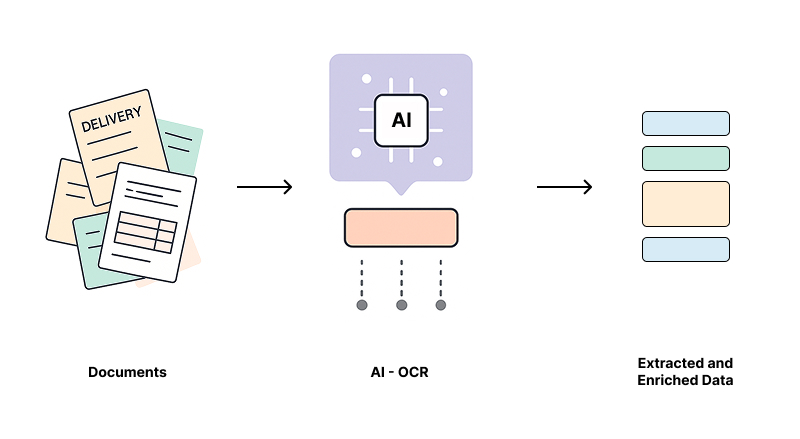
We designed a service that combines OCR extraction with GenAI-based contextual enrichment.
- OCR identifies and extracts raw text.
- GenAI interprets the extracted text in the organization’s context (e.g., mapping “vendor code” across multiple layouts).
- When needed, the system enriches fields with information from other sources.
- Output is returned in a structured, machine-readable format for users or downstream systems.
Key Considerations
Building a production-ready solution required attention beyond the core workflow:
- Data Privacy
The client’s concern about sensitive commercial data was addressed by hosting an open-source LLM in their own GPU instance. All processing stayed within their environment. - Accuracy
The system was able to correctly associate about 95% of the required fields with the right data from the scanned delivery slips. - Performance
The service was tuned to deliver responses quickly enough to integrate seamlessly into operational workflows. - Integration
Output was designed in a structured format that downstream systems could consume without additional transformation.
Outcome
The pilot showed that combining OCR with GenAI can reliably process messy documents, achieving 95% correct field associations and significantly reducing manual effort, while meeting the client’s privacy and performance requirements.
- Build time: 1 month from design to deployment
- Accuracy: ~95% in pilot tests
- Impact: Reduced manual data entry effort and enabled faster downstream processing
- Adoption: Pilot users satisfied with progress and eager for broader rollout