A Non-Technical Founder, Claude, and a Working Software Product
What a recent technical assessment taught me about the changing economics of building software.
A non-technical founder used Claude to build a working product good enough to demo to customers and investors. My technical assessment found real gaps for production: security, scalability, database design, and technical debt. But the bigger story is that AI has dramatically reduced the cost of finding out whether a software idea is worth pursuing. Engineering expertise still matters; it now comes in after validation, not before.
I recently took on a particularly interesting consulting engagement through Samagra, the company I founded. I was introduced to a startup founder in Germany who has an ambitious idea to disrupt how properties are bought and sold.
He understands the real estate industry, has thought deeply about the problem, and has validated his idea on the ground. But he is not a software engineer. He doesn't have a technology team either.
What he does have is Claude.
Using AI coding agents, he managed to turn his idea into a working software product that he could demonstrate to prospective customers and angel investors. Not just a few screens or a clickable mockup, but an actual application with a frontend, backend, database, and working business logic.
That alone is remarkable.
But what impressed me equally was the founder's judgment. He understood that getting a product to work and getting it ready for production are two very different things. Before putting it in the hands of real users, he wanted an independent technical assessment.
That's where I came in.
What can AI really build without an engineer?
I was particularly excited about this engagement because I wanted to answer a question for myself: How far can a smart, non-technical founder with a well-thought-out idea go with just an AI coding agent?
Before the era of AI coding agents, someone in his position would probably have had to find a technical co-founder or hire a software development agency, perhaps offshore to keep costs manageable. There would have been weeks of requirements discussions, months of development, and several rounds of iterations before he had something substantial enough to demonstrate.
And that's assuming he found the right team.
Today, someone with a clear idea, sufficient patience, and the ability to communicate what they want can get surprisingly far on their own.
But I was curious about the other side of this equation. What happens when the person guiding the AI doesn't know enough about software architecture, security, scalability, or maintainability to recognize when the AI is taking a wrong turn?
So I started reviewing the platform.
And boy, was I impressed with what Claude could accomplish in 2026!
Software built in its creator's image
There is an old saying that God created man in His image. As I went through the codebase, I couldn't help thinking that software built using AI coding agents follows a somewhat similar principle.
The software reflects the knowledge, priorities, and blind spots of the person directing the AI.
If you ask the agent to build something quickly, it optimizes for getting it working. If you ask it to pay attention to security, it makes an effort to do so. If you ask it to build reusable components, it can do that too.
But what about the things you don't know you should be asking?
The AI makes assumptions. Lots of them. And it doesn't necessarily stop to explain the long-term implications of those assumptions.
There is also the problem of continuity. Imagine telling an agent early in the project to build a quick prototype, just to see how everything comes together. A few weeks later, after learning more about good software engineering practices, you start asking it to build things properly.
The agent happily obliges.
But it may not point out that your codebase now contains two or three different approaches to solving the same problem. Or that decisions made during the prototyping phase are still deeply embedded in the architecture.
Over time, as context gets lost and new instructions accumulate, these inconsistencies compound.
Of course, there are techniques to manage context, enforce architectural decisions, and guide coding agents more effectively. But that's a different discussion.
What did the technical assessment reveal?
Quite a bit.
The product was functional, and the amount of work completed without an engineering team was impressive. But beneath the working interface, I found several issues that would become serious problems in production.
Some examples:
- Frontend architecture: Very little component reuse. A theme existed, but styles, colors, and fonts were duplicated across hundreds of places. Simple UI changes could become unnecessarily expensive and error-prone.
- Security: Some database access paths lacked adequate authorization controls. This could allow users to access information they were never supposed to see. There were also weaknesses in how incoming emails were verified and trusted.
- Environment management: No separate staging environment to safely test changes before releasing them.
- Backend scalability: Certain blocking operations could hold up other requests, creating bottlenecks as traffic increased.
- Database design: Inconsistent modeling, duplicated information across tables, and missing indexes that could significantly affect performance as the number of users grew.
- Release management: Frontend, backend, and database changes were not being released in a coordinated manner, leaving room for compatibility failures.
- Technical debt: Multiple patterns for doing the same thing, accumulated shortcuts, and implementation inconsistencies that would make future changes increasingly difficult.
None of these problems are particularly exotic. I've seen many of them in software built by human engineering teams too. The quality of software has always depended on the experience, discipline, and judgment of the people building it.
The difference here was how quickly so much software had been created, with no engineering team at all.
So, is vibe coding a bad idea?
Absolutely not.
In fact, this engagement made me even more optimistic about what AI coding agents are enabling.
Can the problems I identified be fixed? Certainly. And AI itself can help fix many of them, especially when guided by someone who understands how to build secure, reliable, and maintainable software.
Are coding agents going to get better? Without a doubt. They're already taking on substantial work that would previously have been assigned to junior developers. Their ability to handle more complex engineering tasks will continue to improve.
But here's what I think is the more important change happening right now.
AI has dramatically reduced the cost of finding out whether a software idea is worth pursuing.
Think about what this founder achieved.
He didn't have to raise a significant amount of money just to build his first product. He didn't need to assemble a team before testing his assumptions. He could translate his domain knowledge directly into working software, demonstrate it to potential customers, gather feedback, and refine his idea.
All at a fraction of the cost and time that would have been required just a few years ago.
That is extraordinary leverage for a founder.
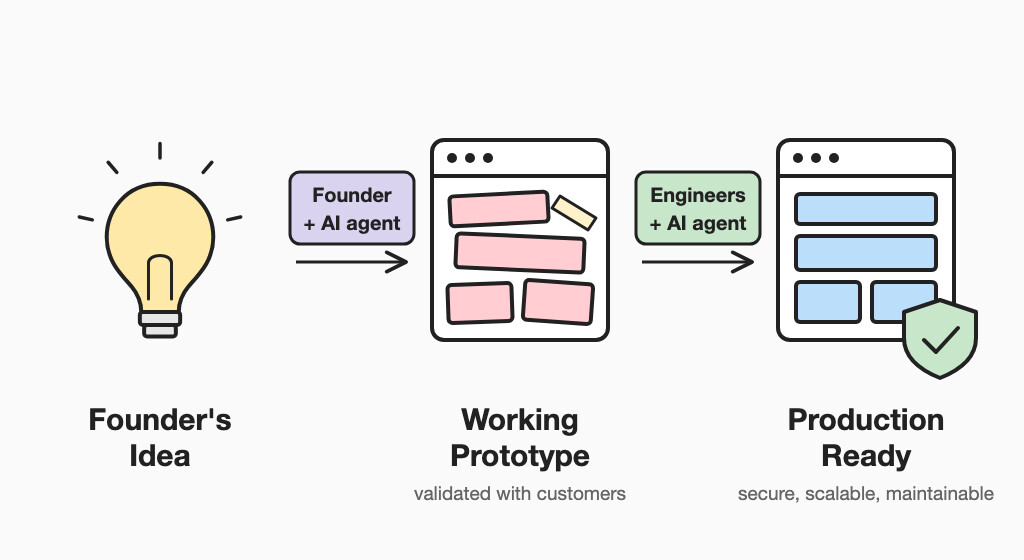
And once there is sufficient market validation and interest, the technical problems can be addressed. Experienced engineers, working with the very same AI coding agents, can strengthen the architecture, fix security issues, improve scalability, and make the product production-ready.
In the worst case, they can even rebuild significant parts of the platform. And they can do it much faster because they already have something incredibly valuable: a working prototype that demonstrates exactly what the founder wants.
I'd argue that, for communicating intended behavior, a working prototype can be far more useful than a hundred-page requirements document.
What has really changed?
We used to spend a significant amount of money building software to find out whether customers wanted it.
Now, founders can find out whether customers want it before spending significant money on engineering it for production.
That changes the game for early-stage startups.
The founder I worked with didn't need to become a software engineer to prove his idea. And he didn't need to pretend that his AI-built prototype was production-ready. He used AI for what it was incredibly good at, then brought in engineering expertise when the nature of the problem changed.
To me, that combination makes a lot of sense.
AI has made it possible for almost anyone with a good idea to build software. But knowing what it takes to run that software reliably in the real world remains a different skill.
And perhaps the biggest opportunity isn't in replacing one with the other, but in bringing those two capabilities together.
What happens to the startup ecosystem when building the first version of a software product is no longer the biggest barrier to entry?